
The Case for Evidence-Based Creative Development in Marketing

Creative work in marketing is often perceived as an art and it is… 🎨
But in the pursuit of brand growth, creativity must also be grounded in data and insights. A growing body of research – led by institutions such as the Ehrenberg-Bass Institute -demonstrates that advertising effectiveness is maximized when creative development is informed by behavioral data, buyer psychology, and empirically validated frameworks.
At Publicis Groupe Denmark we work with an evidence-based approach to marketing and anchor our creative development in marketing science. We look at mental availability, distinctive brand assets, category entry points (CEPs), and the Jobs to Be Done (JTBD) framework and more in order to craft compelling creatives that create true business impact:
Advertising’s Primary Function: Increasing Mental Availability
The Ehrenberg-Bass Institute defines mental availability as the probability that a brand will be noticed or come to mind in buying situations (Sharp, How Brands Grow, 2010). Advertising’s core function is not to persuade, but to refresh and build memory structures that enhance this availability.
Evidence shows that broad-reach, emotionally simple creative—using recognisable brand elements—drives improvements in mental availability. Creative decisions, therefore, should not be left solely to subjective taste or assumed emotional impact. They should be designed to systematically reinforce brand memory structures through salience and consistency.
Distinctive Assets: Memory Triggers, Not Decorations
Distinctive Brand Assets (logos, colours, characters, sounds, etc.) serve as triggers in memory that allow consumers to identify the brand without needing to read or decode messaging. Research from Jenni Romaniuk and Byron Sharp (2004) shows that distinctive assets can act as low-attention processing cues, improving fluency and reducing cognitive load in brand recognition.
Empirical studies indicate that when brands consistently use their distinctive assets across touchpoints, they increase the efficiency of media spend and reduce the cost of building awareness. Importantly, assets must be tested for uniqueness (only associated with the brand) and fame (widely recognized), or they risk becoming generic and ineffective.

Category Entry Points: Mapping Mental Availability to Buying Situations
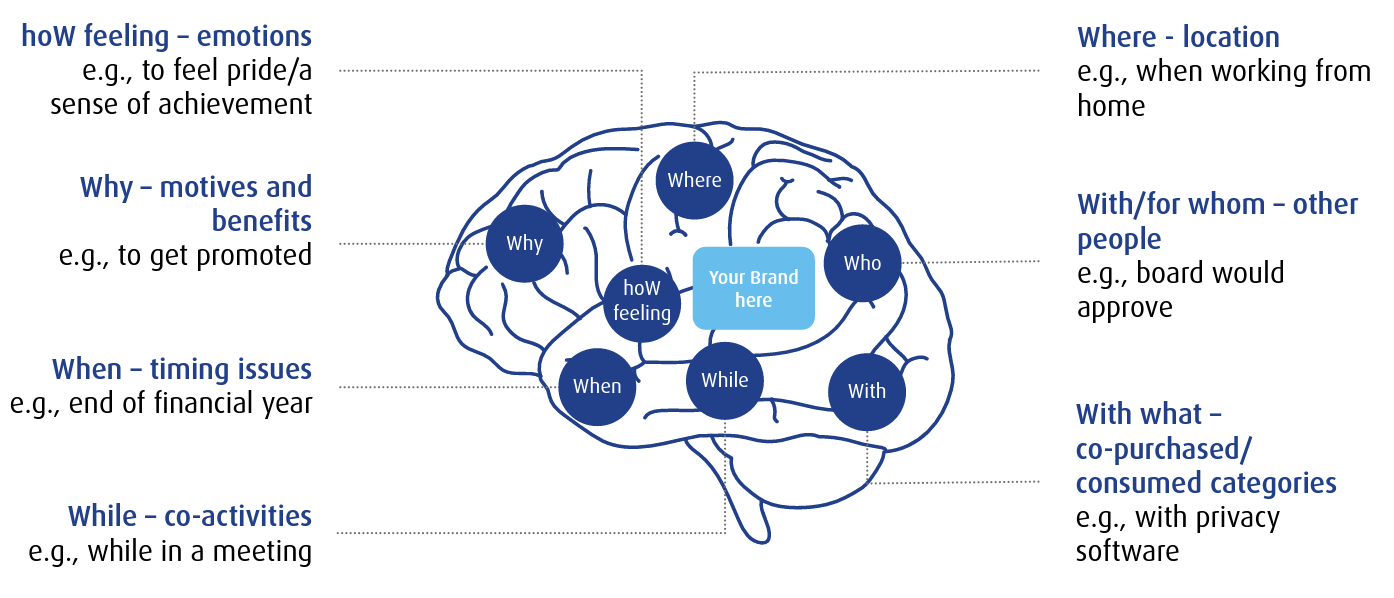
The Category Entry Points (CEPs) concept, also developed at Ehrenberg-Bass, refers to the cues that lead buyers into a category—such as need states, occasions, locations, or social contexts. Advertising should aim to link the brand with as many relevant CEPs as possible.
For example, instead of positioning a coffee brand as “premium,” it is more effective to link it to specific CEPs like “early mornings,” “low energy,” or “catching up with friends.” The broader the array of category entry points a brand is linked to, the greater its mental availability across different buying situations.
Empirical studies show that brands with broader CEP coverage enjoy greater market share growth (Romaniuk & Sharp, 2016). Thus, creative briefs should not be guided by abstract personas or segmentation heuristics alone, but by real-world buying contexts mapped through CEP analysis.
Jobs to Be Done: Functional and Emotional Causality in Consumer Choice
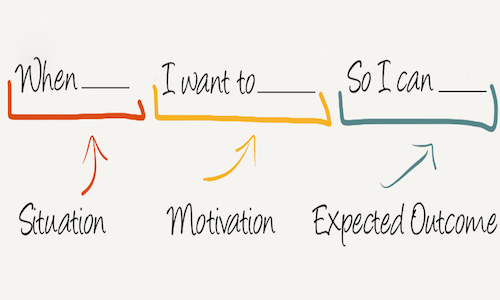
While mental availability captures “when” and “how” a brand is recalled, Jobs to Be Done (JTBD) helps explain “why” a brand is chosen. The JTBD theory, developed by Christensen et al. (2003), posits that consumers don’t buy products—they “hire” them to perform specific functional, emotional, or social jobs.
From a creative development standpoint, JTBD forces marketers to frame communications in terms of outcome-driven use cases. For example, a meal delivery service might serve jobs like “reducing weekday planning effort” or “avoiding decision fatigue after work.”
Creatives that are empirically grounded in consumer JTBD research (e.g., through interviews, ethnography, or usage data) tend to outperform generic benefit-led messaging, particularly in cluttered or low-attention environments.
Some general “laws” to follow for Advertising Effectiveness
On top of the above there are a few other things to consider when taking an evidence-based approach to creative production… Decades of advertising effectiveness research have revealed several laws that should also inform your creative strategy:
- Reach beats targeting. Broad-reach creative is more effective at building mental availability than narrow targeting (Sharp, 2010).
- Emotion works via salience, not persuasion. Emotional creatives drive effectiveness by enhancing memory encoding—not by changing beliefs (Heath & Feldwick, 2008).
- Consistency builds recognition. Variations in tone, look, or messaging reduce distinctive asset linkage and memory retention (Romaniuk, 2018).
- Creativity must be brand-linked. Award-winning creative is ineffective if the brand is not easily recalled (IPA, Binet & Field, 2013).
These laws should be used not as constraints, but as parameters within which effective creative can flourish.
Implications for Marketers
So what are the implications for marketers if they want to follow this approach? An evidence-based creative process implies a shift in how creative work is briefed, developed, and evaluated. Marketers should:
- Use validated pre-testing tools to assess recognition, brand attribution, and linkage to CEPs and assets.
- Anchor briefs in observable buyer behaviour—not attitudinal segmentation or internal stakeholder preferences.
- Ensure consistent use of distinctive assets to reduce cognitive effort and aid recognition.
- Use post-campaign data to track not just impressions or engagement, but improvements in mental availability metrics.
Conclusion
Creativity remains essential in marketing, but it must operate within an evidence-based framework if it is to drive growth. The combination of mental availability theory, distinctive assets, category entry points, and JTBD offers a scientifically robust foundation for creative effectiveness.
I believe that when marketers align their creative processes with empirical insights, they reduce waste, increase efficiency, and build brand assets that endure over time.
What do you think? 😃
Sources:
- Sharp, B. (2010). How Brands Grow: What Marketers Don’t Know. Oxford University Press.
- Sharp, B., & Romaniuk, J. (2016). How Brands Grow Part 2: Emerging Markets, Services, Durables, New and Luxury Brands. Oxford University Press.
- Romaniuk, J., & Sharp, B. (2004). “Conceptualizing and Measuring Brand Salience.” Marketing Theory, 4(4), 327–342.
- Romaniuk, J. (2018). Building Distinctive Brand Assets. Ehrenberg-Bass Institute.
- Heath, R., & Feldwick, P. (2008). “50 Years Using the Wrong Model of Advertising.” International Journal of Market Research, 50(1), 29–59.
- Binet, L., & Field, P. (2013). The Long and the Short of It: Balancing Short and Long-Term Marketing Strategies. IPA.
- Christensen, C. M., Cook, S., & Hall, T. (2003). “Marketing Malpractice: The Cause and the Cure.” Harvard Business Review, December 2005.
- Ehrenberg-Bass Institute for Marketing Science. (Various Reports and Working Papers). Retrieved from: https://www.marketingscience.info

