
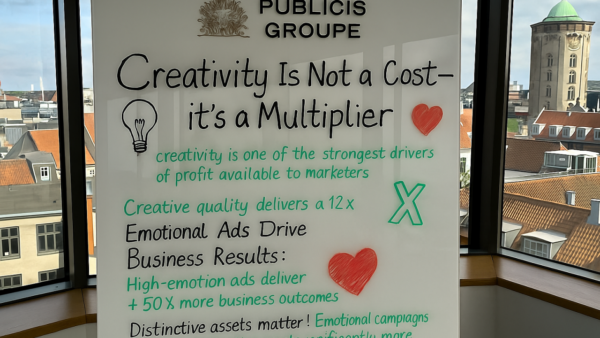
Creativity Is Not a Cost – it’s a Multiplier
In marketing, few things are as universally praised yet under-leveraged as creativity.
We say creativity drives differentiation. We say it builds brands. But when budget season comes around or performance pressure rises, creativity (and marketing in general! 🧐) is often treated as a cost centre. Something to trim. Something “nice to have.”
It’s not. According to a new global study from System1 and Effie Worldwide called “The Creative Dividend”, creativity is one of the strongest drivers of profit available to marketers – outperforming targeting, media optimization, and even budget size.
Yet most marketers lack the confidence, tools, and internal alignment to fully use it. At Publicis Groupe Denmark me and my team work with a evidence-based approach to marketing and creativity and very much welcome these new data points and insights.
To that point I wanted to unpack and distill what the data reveals – and what it means for how marketers should think about brand growth. So here we go:
🎯 The Creative Multiplier: +12x on Profit
System1 analysed 1,265 campaigns across the US, UK and Europe – matched with real-world effectiveness data from the Effie Awards. Here’s what they found:
- Creative quality delivers a 12x profit multiplier.
- By contrast, targeting? Just 1.1x.
- The most awarded creative campaigns had 6.7x higher ROI than non-winners.
Creativity is not soft. It’s not fluffy. Done right, it’s one of the most powerful levers we as marketers have.
😟 So Why Are Marketers Undervaluing It?
The data also reveals a troubling pattern:
- 60% of marketers don’t feel confident their teams can deliver creatively effective work.
- Most default to short-term metrics like impressions, clicks, or conversions.
- Creativity is perceived as risky – especially in the absence of clear strategy and customer insight.
In short and to put it bluntly, the data shows that marketers are “under-skilled”, over-targeted, and under-ambitious!
❤️ Emotional Ads Drive Business Results
I also found this super interesting: One of the most consistent findings in the study was that emotionally engaging campaigns outperform rational ones across every brand and market type.
- High-emotion ads deliver +50% more business outcomes.
- Challenger brands with high-emotion ads grow as effectively as category leaders.
- Emotion boosts market share, loyalty, pricing power and more.
Why? Because emotion builds mental availability – the foundation of long-term brand value.
The study also showed that the “safest” ads – the ones that generate no emotional response- are also the least effective:
- Dull campaigns return 40% less profit.
- Nearly 1 in 3 ads tested generated zero emotional engagement.
- Many ads failed to even clearly link to the brand – 20% of viewers couldn’t remember who the ad was for.
This was similar to what we found in a big Danish research piece we did last year in partnership with Dansk Reklame Film A/S and Neurons (article in Danish): https://bureaubiz.dk/klumme/foelelser-er-en-effektiv-kur-mod-forbrugernes-vigende-koncentration-og-hukommelse/ – here we actually saw the “Neutral” is the most dangerous emotional feeling of all!
🔁 Consistency Compounds Creativity
But even more important is consistency! Because the research also showed that one of the most overlooked drivers of brand growth is creative consistency.
Brands that commit to consistent creative platforms and brand codes are up to 3x more profitable than those that constantly reinvent!
🧠 Why it matters: Consistency helps builds mental availability – the ease with which your brand comes to mind in buying situations. And that availability is built through distinctive brand assets: logos, characters, taglines, colours, sounds, and other recognisable brand codes.
🚨 Yet too many brands underuse them:
- 1 in 5 can’t identify the brand behind the ad
- Ads with strong brand fluency are 70% more likely to build distinctiveness and 52% more likely to drive differentiation
- Emotional campaigns that also use distinctive assets are significantly more profitable over time!
Inconsistent brands were 1/3 less likely to grow differentiation – because without repetition, assets don’t stick!
So the conclusion has to be that it isn’t about running the same ad on repeat. It’s about building a coherent, recognisable brand identity across time, touchpoints, and teams—so that every campaign reinforces what came before.
📈 How to Reframe Creativity as a Growth Engine
So what can marketers (and their CFOs 😀) take away from this research?
Here are my 2 cents:
- ✅ Stop chasing only short-term metrics: Clicks, impressions and conversions are not business outcomes. Revenue, market share, and loyalty are.
- ✅ Invest in emotional storytelling: Ads that make people feel something build brand memory. That memory drives future choice.
- ✅ Use your brand codes: Fluent branding – distinctive assets, visual identity—is critical. Don’t just logo-slap at the end.
- ✅ Be consistent over time: Don’t reinvent the wheel each quarter. Build equity with repetition and evolution—not reinvention.
- ✅ Pair creativity with strategy: Great work isn’t random—it’s anchored in customer insight and business objectives. That’s where creativity earns its seat at the board table.
🚀 From Soft Metric to Strategic Asset
So marketers and agency colleagues, it’s time to change the narrative. Creativity is not a risk. It’s not an art project. It’s not just for Cannes. It’s one of the most powerful strategic levers marketers can use to drive business impact.
If we want our brands to grow, we need to stop treating creativity (and marketing in general! 🧐) like a cost – and start treating it like the growth engine it really is!
If you want to deep-dive into the reserch, here’s the link: https://system1group.com/the-creative-dividend
Let’s include creativity at the core of marketing effectiveness. And let’s measure what matters: profit, penetration, and long-term brand impact.

