
The 95/5 Rule: Why Future Buyers Matter More Than Current Leads!
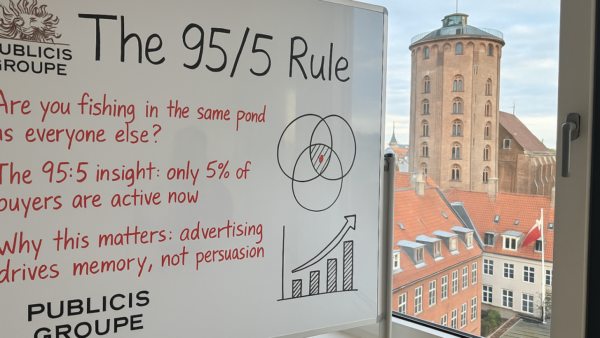
🎣 Are you fishing in the same pond as everyone else?
In today’s data-driven marketing world, focusing only on the active 5% of buyers – the “in‑market” segment – may feel efficient. Yet, research from Ehrenberg-Bass Institute and WARC shows this is a common trap. By ignoring the dormant 95%, marketers risk long-term growth and missing future revenue!
The 95:5 insight: Only 5% of buyers are active now
Ehrenberg‑Bass Institute introduced the “95:5 Rule,” highlighting a simple truth: at any moment, only about 5% of your target audience is in-market, while 95% remain dormant. For example:
- Many B2B services have repurchase cycles of 2–5 years.
- Only ~20% of clients are actively shopping over a year, ~5% each quarter (warc.com).
- Advertising often reaches people who won’t repurchase until months or years later .
That means most marketing efforts appear “inefficient”—but this is not reality… And it is not only B2B. WARC confirms that the 95:5 Rule applies across industries, including luxury retail and FMCG. It’s a heuristic – not a hard law – but a powerful insight into purchase dynamics.
Marketers like Tyrona (Ty) Heath from LinkedIn’s B2B Institute emphasise that ads work by building memory – triggered later when a buyer enters the market.
The “95/5 Rule” highlights that only about 5% of your potential customers are actively looking to buy at any given time, while the remaining 95% are not currently in the market
Why this matters: advertising drives memory, not persuasion
Traditional logic sees marketing as persuasion—using ads to nudge buyers down the funnel. But Ehrenberg‑Bass flips this view. Since most people aren’t buying now, ads work by building memory links, not prompting immediate purchase
John Dawes explains that ad impressions accumulated over time ⏤ even when the buyer isn’t in-market ⏤ increase the chance of being remembered when it matters. Ty Heath reinforces this, noting that buyers choose the brand that comes to mind first—so it’s essential to establish those category entry points early.
The cost of fishing in the same pond
So what does it cost? (this is where the CFO normally wakes up 😉). You can put it like this: Relying exclusively on in-market leads AKA the 5% has three downsides:
- Escalating costs: As demand signals become crowded, CPA/CPL keeps rising.
- Limited differentiation: Everyone targets the same 5%, leading to commoditised competition.
- Low mental availability: Brands absent from buyers’ memories risk being ruled out during future purchase windows.
Broadening the client base: What to do?
So as a marketer what do you do if you wan’t to capture long-term growth? You can start by integrating the short term and long term strategies i.e.:
- Objective-Focused-Tactics to Capture current demand In‑market (5%) i.e. Paid search, retargeting, lead gen campaigns, intent data
- Build future demand to capture “Out‑of-market (95%)” target audience through brand advertising (awareness and creatives that builds brand memory), thought leadership, broad-reach media, category entry points (e.g., “When X happens, think of us”) etc.
And if you are still struggling with where to start or want to dive a bit deeper, here are a few “real-world frameworks” that supports combining and broadening your strategy:
- Binet & Field’s 60:40 rule: Recommend allocating ~60% of budget to brand-building and 40% to activation. Many B2B brands reverse this—and lose long‑term impact.(warc.com, marketingscience.info)
- Category Entry Points: Brands must appear across many relevant contexts. More entry points = broader mental availability and easier access when need arises (earnest-agency.com).
- Double Jeopardy Law: Smaller brands suffer twice: fewer buyers and less loyalty. Building memory among the 95% reduces this effect over time (en.wikipedia.org).
And don’t forget: Measure brand health, not just sales. Track metrics such as unaided recall, mental availability, and brand salience + monitor whether your brand is top-of-mind when buyers enter the market.
Tactical playbook: So how do you action this today?
- Audit your client base: Segment buyers by purchase cycles to identify the true size of “in-market” at any moment. Note: if your category cycle is shorter, shift budget accordingly!
- Rebalance media investments: Set aside ~60% for long-term brand reach; 40% for demand capture (different industries have small skews either way…)
- Define category entry points: Map typical purchase scenarios (e.g., “when my fridge is empty”, “my car breaks down”) and anchor your messaging accordingly.
- Activate throughout the funnel: Pair brand campaigns (talking to the 95%) with performance tactics for immediacy.
- Track mental availability: Use brand health tools to measure recall and associations among dormant buyers.
- Iterate and learn: Always keep on learning and innovating i.e. adjust in/out-market splits based on data
The payoff: Growth!
By broadening your client base:
- You reduce dependency on intent-targeted audiences.
- You increase brand salience and emotional connection.
- You grow pipelines that don’t just fill quickly—they sustain.
- You improve valuation—since broad mental availability fuels brand equity and future cash flows
Net net: The 95:5 Rule isn’t a neat formula—it’s a strategic lens. It calls on marketers to fish beyond tomorrow, expanding the brand to reach its future buyers; to drive sustainable growth, you need to balance your hunt for the 5% in-market right now with casting your net wide across the 95%!
List of 📚 Sources:
- Ehrenberg‑Bass Institute – The “95:5 Rule” highlights that only ~5% of B2B buyers are in-market at any given time; 95% are out-of-market and ad effectiveness depends on building memory markers for future purchases (business.linkedin.com, marketingscience.info).
- WARC – Confirms the heuristic nature of the 95:5 Rule: ~20% of buyers in-market annually, ~5% quarterly, stressing the importance of brand reach beyond active buyers (warc.com).
- LinkedIn B2B Institute (Ty Heath) – Emphasises ads create lasting impressions. The manager who bought an Aston Martin did so years after first seeing an ad, supporting the need to build memory early (business.linkedin.com).
- WARC / Binet & Field – Advocates for balanced investment in brand health and category entry points, relevant to out-of-market buyers (warc.com).
- Ehrenberg‑Bass “How B2B Brands Grow” report – Covers the 95:5 Rule, Double Jeopardy, and the power of mental & physical availability (marketingscience.info).